By Shuli Wong
UNITED NATIONS, Jul 30 2026 – The Democratic Republic of Congo (DRC) is battling the fastest-growing Ebola outbreak on record, with United Nations officials warning that hunger is actively undermining efforts to contain the spread.
“Ebola feeds on delay, fear and hunger,” said Carl Skau, acting director of the World Food Programme (WFP) on Wednesday, July 29.
The current outbreak, declared on May 15th and caused by the Bundibugyo species of Ebola, is the third largest outbreak ever recorded, said Dr. Chikwe Ihekweazu, Executive Director of the World Health Organization’s (WHO) Health Emergencies Programme. The outbreak in the DRC is reaching unprecedented levels, Dr. Ihekweazu noted. “Over the last few days, we’ve seen some of the highest numbers of new infections in a single day.”
As of July 29th, the DRC outbreak has reached over 3,200 cases, with the virus spreading to 48 health zones across five provinces in eastern DRC. Unfortunately, WHO’s modeling has indicated that the true scale of the outbreak could be two to four times higher than the reported cases. Furthermore, 80 percent of new cases are coming from unknown chains of transmission, and many newly reported deaths are from people who never reached a health care facility or received care.
Julien Harneis, the UN’s Senior Ebola Coordinator, discussed how a critical driver for Ebola transmission is the fact that people are dying in their communities rather than in the care of a hospital or treatment center.
“Roughly 60 percent of deaths are occurring in the community, at the point when viral load — and risk to caregivers — is highest,” said Mr. Harneis.
WHO officials have mirrored this concern, calling deaths that occur outside of health facilities “the most alarming finding.” While there is no approved treatment for the Bundibugyo species of Ebola, the chances of survival are significantly higher with early supportive care.
On top of the outbreak is a severe hunger crisis that is exacerbating the impact and spread of Ebola. Across eastern DRC, nearly 10 million people are facing crisis- or emergency-level hunger. Ituri, the epicenter of the outbreak, is also the DRC’s most severe hunger hotspot, with 1.9 million people at crisis levels of food insecurity or worse. Mr. Skau emphasized how “food assistance is frontline Ebola containment. It helps families stay home, supports safe isolation, builds trust with communities and keeps health teams moving.”
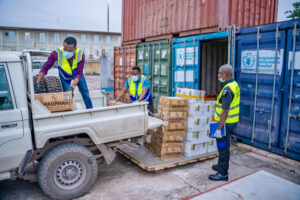
The WFP has already delivered more than 160,000 hot meals to patients and frontline workers across 17 treatment and isolation centers. Dry food rations have been provided to 23,000 people, including 14,000 under quarantine, and an additional 36,000 people in Ebola-affected zones have been provided general food assistance. While discussing WFP’s work, Mr. Skau stressed how food logistics support is central to containing the outbreak. “You cannot force people to choose between hunger and health,” he said.
However, funding to tackle the interconnected hunger and Ebola crisis remains critically underfunded. WFP needs USD 293.6 million over the next six months to sustain all operations in DRC, including $76 million for the regional Ebola responses and $50 million for food and nutrition assistance.
“$76 million is the ask and that’s frankly just peanuts, if you look at the bigger scheme of things,” said Mr. Skau. Furthermore, while WFP’s logistics have been somewhat funded, the food element has received no funding. Mr. Skau emphasized, “if you want to be effective, you need to have an all rounded response. It’s not only the health response that is needed to be able to contain that.” Mr. Harneis added that in addition to the food assistance needed, the broader $1 billion Humanitarian Needs and Response Plan is only 45 percent funded.
WHO and WFP officials are urging the international community not to lose focus, as Dr. Ihekweazu warned: “now is not the time to drop the ball.” Mr. Harneis and Mr. Skau called for further action and to “scale up the Ebola response, three, four, five times of what we are doing now.”
Mr. Skau linked the urgent funding need to a broader appeal for political attention, describing the DRC as “exhausted from years of conflict, from repeated displacement, from crisis after crisis after crisis.” He argued that ending the outbreak will require more than just medical and food assistance: “We need peace, we need security…for all of this, we need funding…the funding that is coming here is far from enough and we need political attention.” In the weeks ahead, a rapid increase in funding and political will is needed to change the outbreak’s trajectory.
IPS UN Bureau Report
!function(d,s,id){var js,fjs=d.getElementsByTagName(s)[0],p=/^http:/.test(d.location)?’http’:’https’;if(!d.getElementById(id)){js=d.createElement(s);js.id=id;js.src=p+’://platform.twitter.com/widgets.js’;fjs.parentNode.insertBefore(js,fjs);}}(document, ‘script’, ‘twitter-wjs’);