
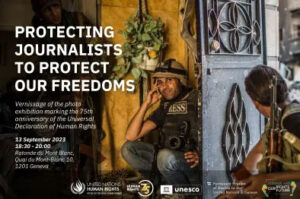
Credit: Mauricio Morales Source UNESCO
By Alon Ben-Meir
NEW YORK, Jul 23 2026 – Under a new rule proposed by the Department of Homeland Security, the duration of “I visas” for foreign media will be slashed from renewable multi year periods—often up to five years—to a maximum of 240 days, and just 90 days for Chinese journalists. Renewals would no longer be a routine administrative step tied to continued employment and compliance with the law, but a discretionary privilege the government can grant or withhold at will.
Turning Journalist Visas into a Weapon
The Foreign Press Association and other media organizations have warned that such a regime will make it “impossible” for correspondents to do their jobs: they cannot build sources, understand the country’s complex politics, or maintain anything resembling a family life if their legal status expires every few months and is constantly subject to political whim. The Association of Foreign Press Correspondents in the United States rightly calls this a “flagrant attack on press freedom” designed to chill coverage by making unfavorable reporting a potential visa liability.
An Assault on the Spirit of the First Amendment
Formally, the First Amendment binds Congress, not consular officers or immigration regulators. But in substance, the proposed rule is a direct affront to the First Amendment’s core principle: that a free press must be able to scrutinize those in power without fear of retaliation.
By conditioning a journalist’s ability to live and work in the United States on repeated, discretionary renewals, the administration is creating precisely the climate of self censorship that the First Amendment was meant to prevent. If a reporter knows that a critical story about the president or his allies might translate into a denied extension, the line between immigration policy and political reprisal evaporates.
This is not a hypothetical danger. The rule expressly allows the government to scrutinize the “content” a journalist is covering when deciding whether to grant an extension, opening the door to ideological filtering of who gets to report from the United States. That logic is indistinguishable from the methods long used by authoritarian regimes that the United States has historically condemned.
A Tool for Selective Punishment
The proposal also creates a ready made instrument for selective punishment of journalists from countries with which the Trump administration has tense or adversarial relations. The singling out of Chinese journalists for especially harsh 90 day limits is an explicit signal that Washington is prepared to wield visa policy as a geopolitical stick, not a neutral administrative tool.
Once this precedent is established, nothing prevents the administration from tightening the screw further on reporters from other states whose governments it wishes to pressure—or punish. The result would be a two tiered press landscape in which journalists from favored countries enjoy relative stability, while those from disfavored states face constant uncertainty and the implicit demand to “behave.”
Collateral Damage to US Society and Industry
The damage, however, would not be confined to newsrooms. International coverage of the United States is a critical artery for sectors that depend on global visibility and confidence, including finance, higher education, entertainment, sports, tourism, and cultural institutions. If it becomes prohibitively expensive or logistically impossible for foreign outlets to station correspondents in the US for more than a few months, many will simply relocate their hubs elsewhere.
That relocation carries a cost: fewer nuanced stories about American democracy, markets, universities, and culture, and more reliance on second hand or adversarial narratives. For a country that still claims leadership of a “free world,” deliberately undermining the global visibility of its own society is more than self defeating; it is profoundly hypocritical.
Undermining Treaty Commitments and Global Standing
There is an additional, often overlooked dimension: these restrictions risk clashing with US obligations under the UN Headquarters Agreement and related arrangements governing access for foreign journalists covering the United Nations. New York is not only an American city; it is the seat of an international organization whose work depends on open media access from all member states.
For decades, Washington has rightly insisted that host states of international institutions must guarantee access to the press and avoid politicizing visas. If the United States itself begins to weaponize journalist visas, it hands every authoritarian government a ready made excuse to do the same, eroding what remains of an already fragile global norm.
What Must Be Done
This proposal is not inevitable. It is a regulatory measure that can be challenged, delayed, and ultimately defeated through a combination of legal action, congressional oversight, diplomatic pressure, and public mobilization. Media organizations, civil liberties groups, universities, and US industries that depend on international coverage should submit formal complaints, petition Congress to block implementation, and prepare litigation arguing that the rule is arbitrary, discriminatory, and incompatible with the constitutional protection of a free press.
Foreign governments and international bodies, including the UN, should make it clear that undermining foreign press access in the United States will invite reciprocal restrictions on American journalists abroad—further isolating US audiences from the world. And American citizens, who ultimately bear the cost of an information starved public sphere, must insist that their government not abuse immigration law as a backdoor censorship tool.
It is no accident that Trump, who is openly hostile to independent media, now seeks to transform visas into levers of control over who may report on it. If this rule stands, it will not only harm thousands of foreign journalists and their families; it will further entrench a creeping authoritarianism in America that fears scrutiny above all else, and that is precisely why it must be stopped.
Dr Alon Ben-Meir is President, Institute for Humanitarian Conflict Resolution
IPS UN Bureau
!function(d,s,id){var js,fjs=d.getElementsByTagName(s)[0],p=/^http:/.test(d.location)?’http’:’https’;if(!d.getElementById(id)){js=d.createElement(s);js.id=id;js.src=p+’://platform.twitter.com/widgets.js’;fjs.parentNode.insertBefore(js,fjs);}}(document, ‘script’, ‘twitter-wjs’);


Excerpt:
For nearly a century, foreign correspondents have come to the United States precisely because this country prided itself on welcoming scrutiny. Now, the Trump administration proposes to turn that legacy on its head—by transforming visas for international journalists into instruments of control
